 Notes by
The book in a minute
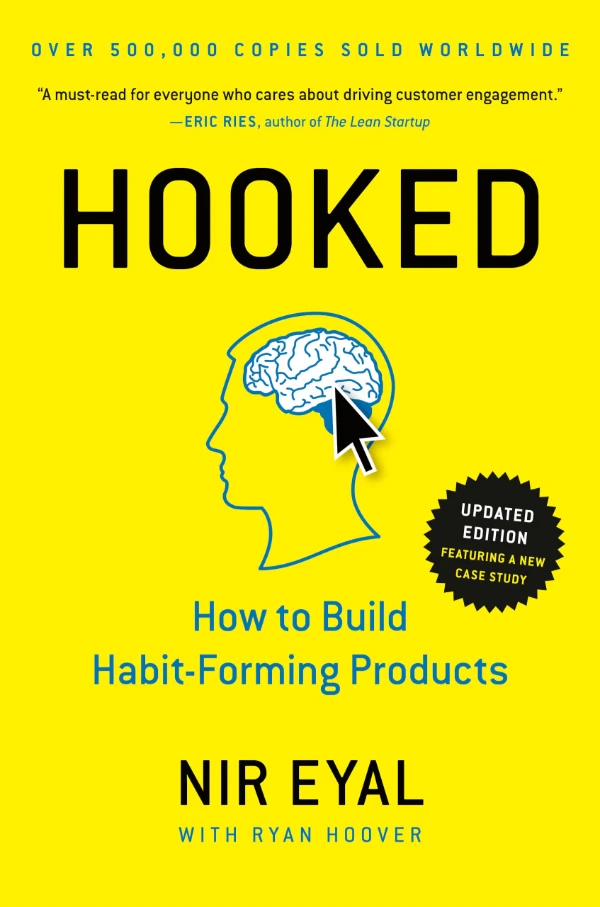
Hooked explains how some products become habits that people use with no reminder at all. It is written by Nir Eyal with Ryan Hoover, and was published by Portfolio in November 2014.
The core of the book is the Hook Model, a loop of four steps: a trigger, an action, a variable reward and an investment. Each pass through the loop makes the next one more likely, until the user starts it without any outside prompt.
The later chapters show how to test whether your product really forms a habit, and ask when building one is fair to the user. The examples come from American consumer tech, but the loop applies to any product people use often.
Four reasons it earns your time
Retention is what investors check first
A growth chart can be bought with ads. Users who come back on their own cannot. This book is about the second kind.
A model you can draw in ten minutes
Four steps and one loop. Sketch your product's loop on a whiteboard and you will see where it breaks.
It starts from a feeling
Lasting habits begin with something the user already feels, such as boredom or the fear of missing out. That changes how you write your problem slide.
It asks whether you should
The book ends with a test for when a habit helps users and when it only uses them. Good founders ask that early.
Eight lessons for founders
Start with the itch, not the feature
Eyal calls feelings internal triggers. They are often negative ones such as boredom, loneliness or uncertainty. A product becomes a habit when it is the first thing a user reaches for to ease that feeling.
Outside triggers only start the loop
Notifications, emails, ads and word of mouth bring the first visits. Eyal sorts them into paid, earned, relationship and owned triggers. The aim is to move users from your triggers to their own.
Make the action effortless
Eyal uses BJ Fogg's model: a behaviour happens when motivation, ability and a trigger meet at the same moment. Making the action easier usually works better than adding motivation.
Rewards must vary
A reward that never changes gets boring. Eyal names three kinds that keep people coming back: rewards of the tribe, which are social; of the hunt, for things and information; and of the self, for mastery and completion.
Ask users to put something in
After the reward, users invest: data, content, followers, reputation or skill. Stored value makes the product better the more it is used, and it sets up the next trigger.
How often decides the habit
Eyal plots habits on two axes: how often a behaviour happens and how useful it feels. Something used every day can become a habit easily; something used once a month has to be far more useful to get there.
Test for habit before you scale
Eyal's habit testing has three steps: find your habitual users, codify what they did that others did not, then change the product so new users follow the same path.
Use the manipulation matrix
Eyal asks two questions: would you use the product yourself, and does it materially improve your users' lives? Yes to both makes you a facilitator. The other answers make you a peddler, an entertainer or a dealer.
Four steps, one loop
Source: Hooked, Nir Eyal (Portfolio, 2014)
Read it or skip it
You are building a consumer app, a community or a marketplace that needs people to come back.
Your retention curve flattens too low and you do not know why.
You want to explain your product loop to investors in one picture.
You sell to enterprises that buy once a year. The sales process matters more than habit.
You want hard data. The book is a framework with examples, not a study.
About Hooked
What is the Hook Model?
A four step loop from Nir Eyal: trigger, action, variable reward and investment. Repeated often enough, it turns a product into a habit.
Is Hooked useful for Indian founders?
Yes. The examples are American, but the loop is the same for any app people open every day, from payments to learning. Use it to design your onboarding and to explain retention in your pitch.
Who wrote Hooked?
Nir Eyal, with Ryan Hoover as editor. It was published by Portfolio in November 2014.
Is it fair to build habit forming products?
Eyal's own test is the manipulation matrix: build a habit only if you would use the product yourself and it materially improves your users' lives.
Keep reading
On the traction slide, show the slope, not the screenshot
A single number is a snapshot and snapshots can be staged. A slope is a story.
5 February 2026ReadThe unit economics slide that closes rounds
Show you make more from a customer than it costs to win and keep them and the pitch stops feeling like hope.
3 February 2025ReadInvestors don’t fund ideas. They fund momentum.
The idea is rarely the variable between a yes and a maybe. The slope of the line almost always is.
27 April 2026ReadSend me your deck
I have built decks and models for 2,000+ founders. Book a call and we will go through yours slide by slide.