 Notes by
The book in a minute
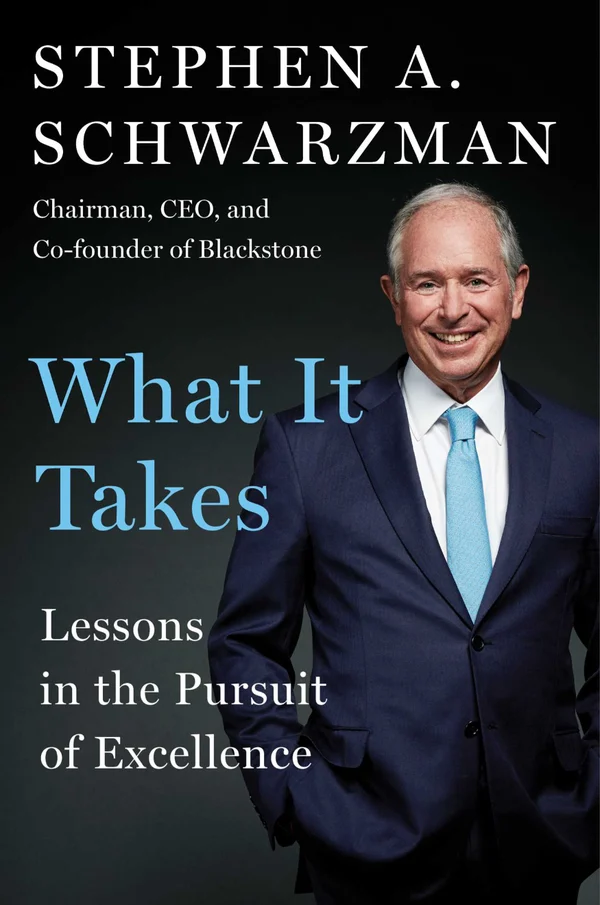
What It Takes is Stephen Schwarzman's account of how he built Blackstone, from a two person firm in 1985 into one of the largest investment firms in the world. He and Pete Peterson started it with $400,000 of their own money.
The middle of the book is the part founders should read slowly. It covers the first fund, raised with no track record, the 1989 deal that lost most of its investors' money and the review process Blackstone built after it, so that no single person could make that call again.
The last part moves to philanthropy and public service, including Schwarzman Scholars at Tsinghua University in Beijing. The book closes with 25 rules for work and life.
Four reasons it earns your time
A real fundraising story
Schwarzman set out to raise a $1 billion first fund with no track record. The anchors, the long road and the close are all on the page. It is the closest thing to sitting in those meetings.
Honest about failure
He writes about the Edgcomb loss in detail and about what it changed. Few business memoirs give a mistake this much room.
Rules you can use on Monday
The book ends with 25 rules for work and life. Most of them work as well in a ten person startup as they did at Blackstone.
How a firm becomes an institution
Hiring, culture and process, told by the person who built them. Useful once your company grows past the founders.
Eight lessons for founders
Pick the big problem
Schwarzman's view is that a big goal takes about the same effort as a small one, and it attracts better people and more capital. Blackstone set a $1 billion target for its first fund with no track record to show.
Get the anchor first
The first fund moved when Prudential and Nikko Securities committed. After Nikko came in, a week of meetings in Japan brought in investors who put up close to 40% of the fund.
Treat every no as data
In the early months Blackstone sent hundreds of letters and won almost no business. The founders kept going and kept sharpening the pitch.
No single person makes the call
In 1989 Blackstone bought Edgcomb Metals, a steel distributor. Steel prices fell and investors lost most of what they had put in. After that, no deal went ahead on one person's conviction. Every deal went through a group review built to find what could go wrong.
Use worry as a tool
In his telling, worry is how you spot risk early. The work is to list every way a plan can fail and deal with each one before it happens.
Hold a very high bar for people
Schwarzman credits much of Blackstone's growth to the people it hired. He kept the bar high because strong people draw more strong people.
Solve other people's problems
One of his rules is to think about the problems of the people you meet and offer to help. That is how relationships start, long before anyone needs anything.
Decide when you are ready
Another rule: make decisions when you are ready, not when someone pushes you. Pressure is often the other side's strategy.
A raise with no track record
Source: What It Takes, Stephen A. Schwarzman (2019)
Read it or skip it
You are raising your first round and want to see how a hard raise is really won.
You are hiring your first leaders and want a bar for what good looks like.
You make decisions where one mistake can cost real money.
You want a private equity textbook. This is a memoir with lessons in it.
You only want business. The last part is mostly philanthropy and public service.
About What It Takes
Is What It Takes worth reading for founders?
Yes, if you are raising money or building a team. The first fund story and the Edgcomb chapter are worth the book on their own.
What is the main lesson of What It Takes?
Aim at a big problem, build a process that looks hard for what can go wrong and keep going after rejection.
Who wrote What It Takes and when was it published?
Stephen A. Schwarzman, chairman, CEO and cofounder of Blackstone. It was published in September 2019 by Avid Reader Press, an imprint of Simon & Schuster.
Is the book only about private equity?
No. Blackstone is the setting, but most of the lessons are about people, decisions and risk. They apply to any company that is growing.
Keep reading
Investors don’t fund ideas. They fund momentum.
The idea is rarely the variable between a yes and a maybe. The slope of the line almost always is.
27 April 2026ReadFundraising is a sales process. Run it like one.
A pipeline, a qualification stage, objections and a close. Treat it like one and it stops feeling random.
4 June 2024ReadWhy warm intros beat cold decks and when they don’t
An endorsement borrows credibility before you’ve said a word. But a great cold approach can still win.
3 July 2024ReadSend me your deck
I have built decks and models for 2,000+ founders. Book a call and we will go through yours slide by slide.