 Notes by
The book in a minute
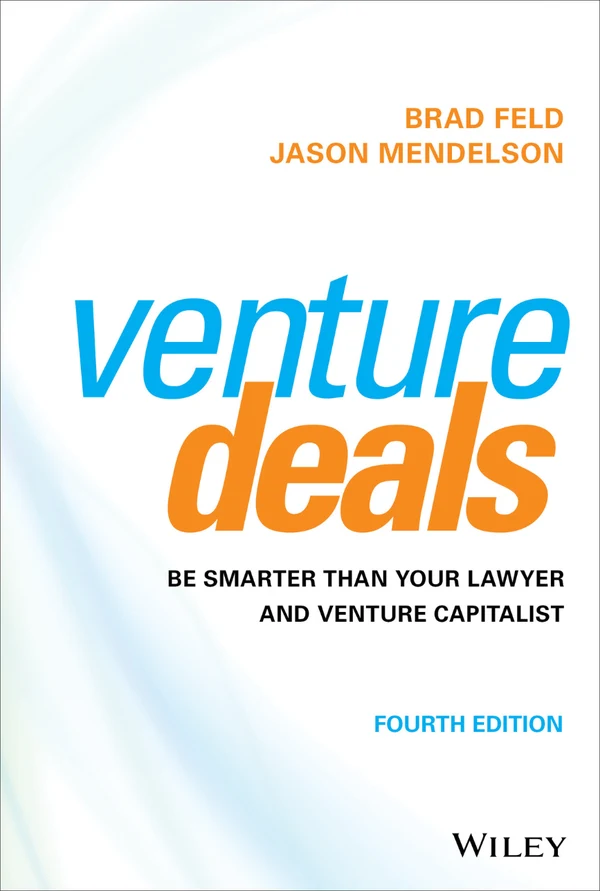
Venture Deals explains how venture capital deals are put together. It is written by Brad Feld and Jason Mendelson, cofounders of the venture firm Foundry Group. It was first published in 2011; these notes follow the fourth edition, published by Wiley in 2019.
Most of the book walks through a term sheet line by line. It sorts every term into two groups: economics, which decides who gets what money, and control, which decides who gets to make which decisions.
The later chapters cover convertible notes, cap tables, how venture funds themselves work and how to negotiate. The book is written for US deals, but the logic carries straight over to term sheets in India.
Four reasons it earns your time
Every founder who raises signs one
If you raise, you will sign a term sheet. This book explains every clause before a lawyer bills you for it.
Written from the other side
The authors are investors. You learn what a VC wants from each term, and why.
Two buckets make it simple
Sorting terms into economics and control turns a long document into something you can read and negotiate.
How VC funds really work
Fees, carry, fund life and reserves. Once you know how your investor gets paid, their behaviour makes sense.
Eight lessons for founders
Two things matter: economics and control
Feld and Mendelson sort every clause into one of two groups. Economics is who gets what money in an exit. Control is who can say yes or no to big decisions. Most other terms are detail.
Valuation is not the whole price
If the option pool is created before the round, it comes out of the founders' share, not the new investor's. A higher headline valuation can be worth less than a lower one.
Know your liquidation preference
The preference decides who gets paid first, and how much, when the company is sold. A 1x non participating preference is the usual standard in early rounds.
Watch the antidilution clause
If a later round is priced lower, antidilution protects the investor by adjusting their price. Broad based weighted average is the usual form; full ratchet is far harsher on founders.
Control sits in the board and the vetoes
Board seats and the list of decisions that need investor approval decide how much freedom you keep after the money arrives.
Know how your VC gets paid
Venture funds earn a management fee and a share of the profits over a fund life of about ten years. That is why VCs need very large outcomes and care about timing.
Notes and SAFEs still have a price
Convertible notes delay the valuation, but the cap and discount still set the price. Indian founders meet the same logic in CCDs and iSAFE notes.
Negotiate for a long relationship
Your investor will sit with you for years. Win the terms that matter, give on the small ones and never let a negotiation sour the relationship.
Every term is one of two kinds
Source: Venture Deals, 4th edition, Brad Feld and Jason Mendelson (2019)
Read it or skip it
You have a term sheet coming, or expect one in the next six months.
You are raising on a convertible note, CCD or iSAFE and want to understand the cap.
You want to negotiate with an investor as an equal.
You want India specific legal detail. The book is written for US deals, so pair it with a good Indian lawyer.
You are years away from raising. Come back when a round is close.
About Venture Deals
Is Venture Deals useful for Indian founders?
Yes. The legal forms differ, but economics and control work the same way in Indian term sheets. Use it to understand the terms, then check the details with an Indian lawyer.
What is the main lesson of Venture Deals?
Every term in a term sheet is about economics or control. Know which is which, and negotiate the few that really matter.
Who wrote Venture Deals?
Brad Feld and Jason Mendelson, cofounders of Foundry Group. It was first published by Wiley in 2011, and the fourth edition came out in 2019.
Do I still need a lawyer if I read it?
Yes. The book makes you a better client, not your own lawyer. Pick one who has done many venture deals.
Keep reading
The valuation conversation you’re losing before it starts
Valuation is downstream of demand and demand is something you engineer before the conversation.
8 May 2025ReadHow much to raise: the math founders get wrong
Ask too little and you’re back in the market in nine months from weakness. Work backwards from the milestone.
5 January 2025ReadThe ask slide: name the number, then stop talking
Confident founders suddenly go vague here. Don’t. Name it, then sit in the silence.
3 December 2025ReadSend me your deck
I have built decks and models for 2,000+ founders. Book a call and we will go through yours slide by slide.